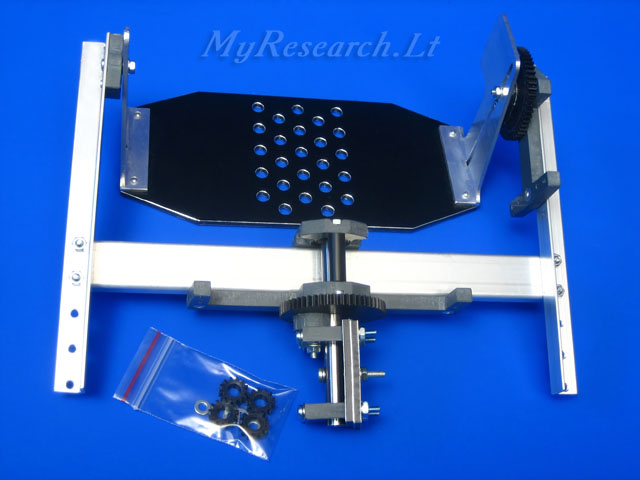
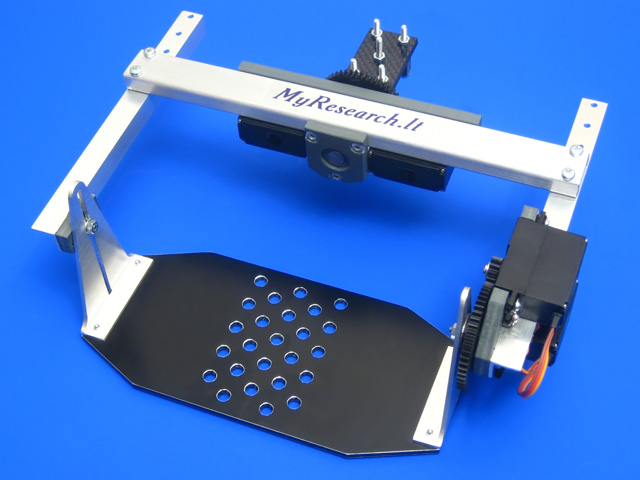
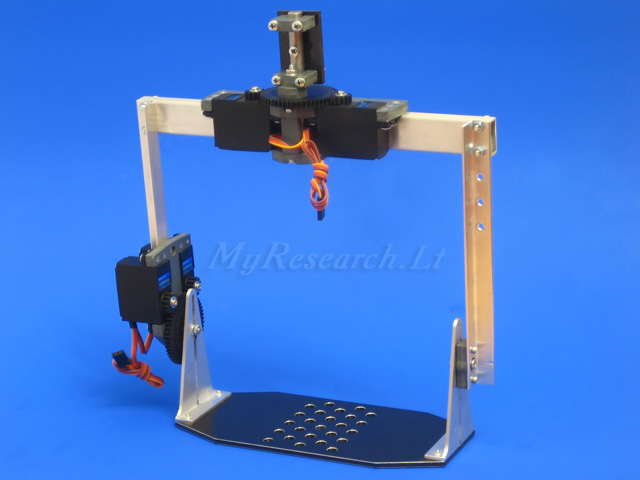
Active Gimbal is the controlled platform for the video-camera, provided with two rotation axles.
In case of the vertical installation with fastening from below or from above, it allows obtaining of the circular panorama and regulation of the tilt of the camera. The platform may be installed on any movable or still object, including different transport vehicles. The fastening is optimized for installation on the radio-controlled helicopter T-Rex 600 Electro. The principle of fastening is simple and the user may adapt the fastening for the other types of models.

Advantages of the platform Active Gimbal:
• The patented double servo-drive, assigned for soft rotation of the camera, is used. It will provide a more clear view.
• The foreseen dimensions allow installation of the professional photo-camera or the manual HD video-camera.
• Presence of the shock-absorbers, assigned for reducing the high-frequency vibrations.
• The possibility of turning for 360 degrees as regards two axles.
• Stability of positioning of the camera along all three axles is secured on the radio-controlled helicopter. Stabilization is secured by gyroscopes.
• The frontal installation on the helicopter allows using the standard undercarriage. It saves the weight and secures better stability and control of the model because the center of mass does not drop down.
• Special attention is paid towards rigidness of the construction by preserving the minimal weight. It allows installation of the heavier video-camera on a small model.
• The set consists out of the fastening, assigned for fixing of the battery of the helicopter T-Rex 600 in the tail part of the body.

A more detailed comparative analysis of active camera mounts is submitted in the article:

> Onboard camera, RC helicopter

Video will be available in the nearest future.

Technical data:
Weight (including four servo-mechanisms) - 400g (14oz)
Permissible mass of the photo/video-camera - 1500g (53oz)
Speed of rotation without the load - 120deg./sec
The dimensions of the construction are indicated on the scheme
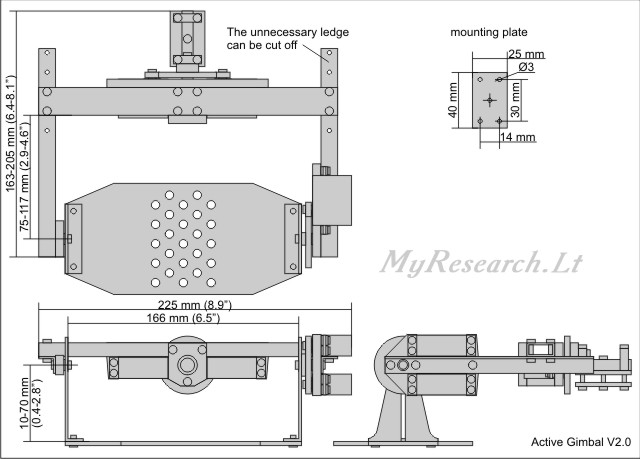
Four servo-mechanisms HS-225MG are installed on the gimbal. The servo-mechanisms are modified for turning for 360 degrees. The servo-mechanisms, operating in conjugation, are tuned for interaction against each other. Each servo-mechanism consumes 20-25 mA in the neutral position.

Use of the gimbal on the radio-controlled helicopter
The gimbal is fixed horizontally, but not vertically on the helicopter. In case of such variant of fastening, the suspension bracket allows achievement of active stabilization of positioning of the camera in the horizontal flatness along the axles of the longitudinal tilt and lateral lurch. Two electronic gyroscopes are used for controlling of these deviations. Stabilization along the axle of the vertical rotation is achieved with the help of the gyroscope, installed on the board.
One person can control the model and the camera. Seeking for this, availability of the extra systems, assigned for stabilization of the model along the optical horizon, height and coordinates, is desirable. If shooting must be done not from the fixed position, but in motion, two control panels are used for controlling the camera and the model. The turn of the helicopter may be controlled from the both control panels. Seeking for this, the signals from two receivers are mixed with the help of the mixer V-Tail. While shooting, the operator orients the model towards the object under shooting, whereas the pilot controls the model, keeping to the set course. Also distribution of the control signals between two control panels is possible on the ground. Read more detailed information about the methods of mixing in the article "Mixing of the control signals from different control panels". The often occurred necessity for the pilot to lead the helicopter sideways serves as the drawback of such control method. The possibility to follow the moving object more precisely serves as the advantage of such method. It is convenient to control positioning of the model at a glance from outside and to follow the set course according to the view of the camera, installed on the board. Device DirectionFinder provides automated pointing of the video-camera to the object, selected for shooting.

Installation of the video-camera
The camera must be installed in such a way so that the center of gravity of the rotating platform coincides with the rotation axles. Seeking for this, it is necessary to remove the gears from the servo and to achieve the balance of the platform. The balance is checked in the horizontal and vertical position of the camera. If the camera’s weight is too big, increase the number of rubber rings on the shock-absorbers. The shock-absorbers must not slip in the course of rotation of the camera.
The information about modification of the servo-mechanisms for "360 degrees" and about the method of tuning the coupled servo-drive is provided in the article "Tuning of the double servo-drive for video-cameras".

Attention, this device is being assembled as per the order. The term of dispatch is 2-14 days.

Price: 240 Euro

If You wish to pay for the goods by the bank remittance or via the Western Union, refer Your order by e-mail.

> Ordering and shipping information

If You wish to use the double servo-drive on the commercial constructions, which are being produced by You, read this information.


All prices and specifications are subject to change without notice